


Top 5 Electric Cars You Can Buy in India in 2026
Top 5 Electric Cars: India’s best EVs for 2026 buyers, from budget to premium, with real-world range, price, and value explained in plain English. Expect clear picks, price bands, and who should buy what—no fluff, just the facts that help you decide today.
Now, here’s the thing—2026 is the year EVs stop feeling “early adopter” and start feeling normal, whether you’re in Bengaluru traffic or cruising the Yamuna Expressway near Noida. This guide zeroes in on the Top 5 Electric Cars that stand out on price, features, mileage, and after sales service—plus what’s upcoming and worth waiting for.(Top 5 Electric Cars)
What sparked the electric car surge in India?
Why is the EV wave hitting Indian cities like Delhi, Bengaluru, Chennai and Kolkata so hard?
Well, for one: tighter emissions rules, rising fuel costs, and stronger government push. Then there’s range anxiety coming down, charging networks improving in Mumbai suburbs, Pune, Hyderabad.
Industry experts at Autocar India point out how traditional makers like Tata Motors and Mahindra & Mahindra are shifting strategy, making EVs more mainstream.
- EV share in India’s passenger car sales has nearly doubled to around 5% in FY26 H1—buyers aren’t just curious, they’re switching. That’s huge momentum.
- October 2025 EV sales and FY25 growth data show sustained demand, with Tata, MG, and Mahindra leading—so choice and support are getting better in 2026.
- With more models under ₹10–20 lakh and better product-market fit for Indian roads, the “electric car price in India” conversation is finally matching real value.(Source)
As a consequence, cities like Ahmedabad, Bengaluru, and Hyderabad now have better charging infrastructure and more showroom choices — meaning your decision isn’t as risky.
Thinking between the new Tata Nexon vs Creta 2025? Here’s a full comparison of design, features, mileage, safety tech, and on-road price. (Top 5 Electric Cars)
What criteria did I use to pick the top 5?
Because “electric car india” is broad, I narrowed down by:
- Range & battery: Enough to cover city + highway without constant worry
- Value for money: Price in Indian rupees, real-world usability
- After-sales & service: Local brand or good network in places like West Bengal, Kolkata
- Features & tech: ADAS, fast charging, features that matter
- Brand / future-proofing: Will this model still have support in 2027-28?
Now, here are the picks (in no strict order) — each will get detailed block: features, mileage, value etc.
1. Mahindra BE 6

My personal favourite. The futuristic design. Mahindra has been working hard to make an EV SUV with serious range and value. The BE 6 offers claimed ranges of up to ~682 km (79 kWh variant). Pricing is also aggressive for what you get: starting around ₹18–19 lakh (ex-showroom) for the base. (Top 5 Electric Cars)
Specs at a glance
Charging infrastructure: still important in your region (West Bengal, Assam, Gujarat).
Value for money? Very strong contender especially if you want high range without luxury prices.
Take-away for you: If you’re around Ahmedabad, Pune or Bengaluru and want a range-monster EV within ~₹20-25 lakh, this is worth serious consideration.
Battery: 59 kWh and 79 kWh options.
Claimed range (59kWh) ~557 km, (79kWh) ~683 km.
Price: ~ ₹18.90 lakh onwards.
What to check/think about
Real-world tests suggest BE 6’s range is notably less than claimed: one test recorded ~439–459 km in highway/city for the 79 kWh variant.
After-sales/service network: Mahindra is strong in smaller towns too, which is a plus.
2. MG Windsor EV — Best family EV under ₹15–18 lakh

Why buy: Space and features with aggressive pricing; MG’s EV push has scaled fast, crossing major sales milestones in FY26.
While less hype than the big names, the Windsor EV offers a solid compact/electric car option in India. It’s especially relevant for city-based buyers (Delhi NCR, Bengaluru). The price range starts more affordable (~₹15–18 lakh ex‐showroom).
Specs & highlights
- Price range: ~ ₹15.05 lakh for some variants in certain cities.
- Compact size, good for urban driving, easier parking in dense zones like Mumbai or Kolkata.
What to check/think about - Range will likely be lower than the large SUVs — for many buyers that’s okay if usage is mainly city commuting.
- Charging in smaller towns may still be slower; home-charging will matter.
Value for money? Good for city-centric buyers who don’t need massive range or AWD.
Take-away: If you create content around “cheap electric car India” or “electric car brand for city India”, this helps illustrate that segment.
3. Kia Syros EV (Upcoming – early 2026 launch)

Why it’s worth watching
Now, here’s where we pivot a bit — this is more “coming soon” but relevant for 2026 buyers. According to reports the Syros EV is expected Jan-Mar 2026, price ~ ₹15-20 lakh and range ~400-450 km.
Specs & value
- Battery / range: Two battery options (42 kWh / 49 kWh) rumored. Range 300-355 km on WLTP for one variant.
- Price estimate: ₹15-20 lakh.
What to check/think about - Launch delays are common — “expected” doesn’t always mean available immediately in your city.
- For 2026 buyers, if you can wait a few months, you may access better value.
Value for money? Yes if you’re planning ahead and don’t need immediate delivery.
Take-away: For your content creation angle, this one plays the “upcoming ev cars in india price 2026” cluster well.
Key comparison table
| Model | Starting Price (approx) | Claimed Range | Stand-out Feature |
|---|---|---|---|
| Tata Harrier EV | ~ ₹21.49 lakh ex-showroom | ~622-627 km | AWD option + large screen tech |
| Mahindra BE 6 | ~ ₹18.90 lakh onwards | ~557-683 km | Best value high-range option |
| MG Windsor EV | ~ ₹15-18 lakh (city pricing) | Moderate (city focus) | Affordable entry EV for urban India |
| BYD Atto 3 | ~ ₹24.99 lakh | Good for segment | Global brand tech in India |
| Kia Syros EV | ~ ₹15-20 lakh (2026) | ~400-450 km | Upcoming value proposition |
4. Tata Nexon EV — Best all-rounder for most buyers

Why buy: Proven track record, frequent updates, and the right mix of range, safety, and resale—still the benchmark under ₹15–17 lakh.
Price band: Starts near ₹12.49 lakh ex-showroom, a sweet spot for EV cars in India price-conscious buyers.
Range and charge: Solid city-highway balance; wide DC fast-charging compatibility.
Value & service: Tata’s EV service footprint is among the widest, which matters if you’re in Tier-2 cities like Indore or Coimbatore. (Top 5 Electric Cars)
Wondering which Tata Nexon variant fits your budget? Explore a detailed breakdown of Tata Nexon all variants — from the base Smart and Pure trims to the top Fearless+ and Dark Editions
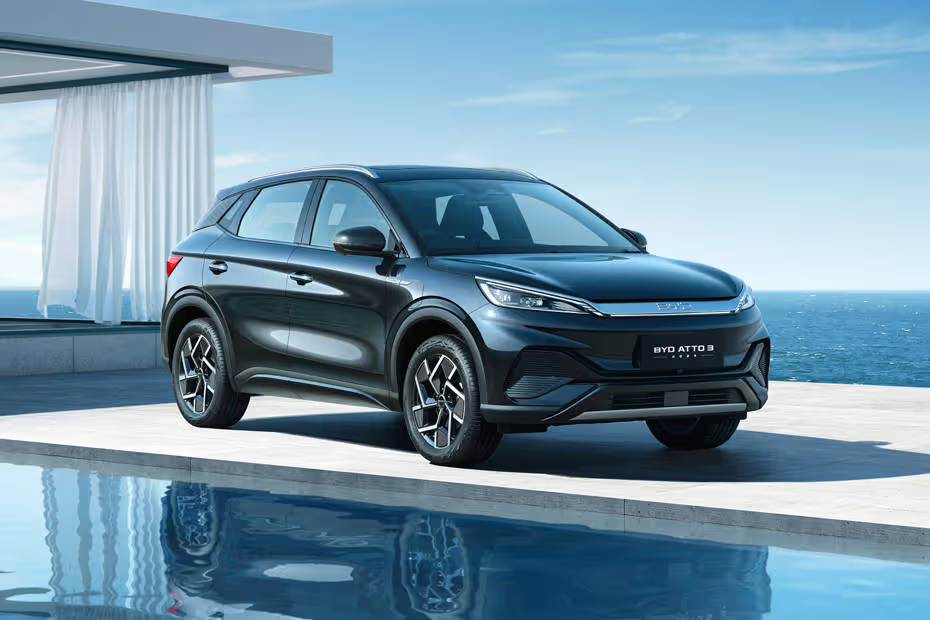
5. BYD Atto 3: Best long-range mainstream upgrade
Why include it
BYD is a global EV player and the Atto 3 brings that tech into India. It showed up on price‐lists of electric cars India in 2025 with ~₹24.99 lakh for some versions.
Specs & value
- Price: ~ ₹24.99 lakh (one quoted figure) for India market.
- Strong international tech pedigree — interesting for content in “electric vehicle price India” cluster.
What to check/think about - Local servicing and parts may still be evolving (depending on the city: Delhi, Chennai, Hyderabad).
- Resale value unknown compared to legacy brands in India.
Value for money? Solid if you want premium feel without going into ultra-luxury.
Take-away: Good option if you cover “electric car brand India – global brands entering India market”.
Public reaction: What people are saying
- “We’re seeing first-time EV buyers who never looked at hybrids—value is landing, especially under ₹15 lakh,” note dealer bodies tracking FY26 H1 momentum.
- “EV market leaders like MG and Tata showed aggressive growth through FY25–FY26,” auto industry coverage confirms, underscoring shifting buyer trust.(Top 5 Electric Cars)
Expert voices: What analysts expect
- Autocar’s 2025–26 outlook flags key launches like Maruti e Vitara, Tata Sierra EV, and compact crossovers that fit Indian city realities—expect mainstreaming by mid-2026.
- ZigWheels’ tracker lists 2025–26 launches such as Mahindra BE 07, Hyundai Inster, and Tata Avinya—expanding choice across body styles and budgets.
Price and segment snapshot
- Cheapest EV you can buy: MG Comet EV from ₹6.24 lakh—city runabout.
- Best under ₹10 lakh: Tata Punch EV (entry variants are close)—balanced starter EV.
- Best value family EV: MG Windsor EV ₹12–18 lakh, spacious and tech-forward.
- Proven all-rounder: Tata Nexon EV—balanced range, features, support.
- Long-range mainstream: MG ZS EV / BYD Atto 3—confidence beyond the city
Should you wait for upcoming EVs in 2026?
- If you want fresh designs and next-gen software, keep an eye on Mahindra BE 07 (Jan 2026) and Leapmotor C10 (Jan 2026).
- If you want a badge-heavy choice, Mercedes-Benz CLA Electric and Skoda Elroq target premium buyers later in 2025–26.
- If budget matters now, today’s Nexon EV/Punch EV deals are compelling—prices are already competitive.
If you’re hunting “electric car India on-road price” or comparing “ev cars in India price vs mileage,” start with Nexon EV and Windsor EV, then test-drive in your city for charging access and after sales service.
If “cheap electric car” is your query, MG Comet EV leads, but for “value for money electric vehicles,” consider Punch EV for real-world usability. For “upcoming ev 2026” and “electric vehicle price India next year,” shortlist Mahindra BE 07 and Hyundai Inster for compact practicality. (Top 5 Electric Cars)
What’s your take on this?
Would you go for the Harrier EV or wait for Kia’s Syros in 2026? Drop a comment below.
If this list helped you even a little, share it with a friend who’s eyeing an EV. Because honestly, most people still have no clue how close we are to mainstream electric cars in India.

Discover more from Fazlamo Express
Subscribe to get the latest posts sent to your email.


